
6 January, 2026
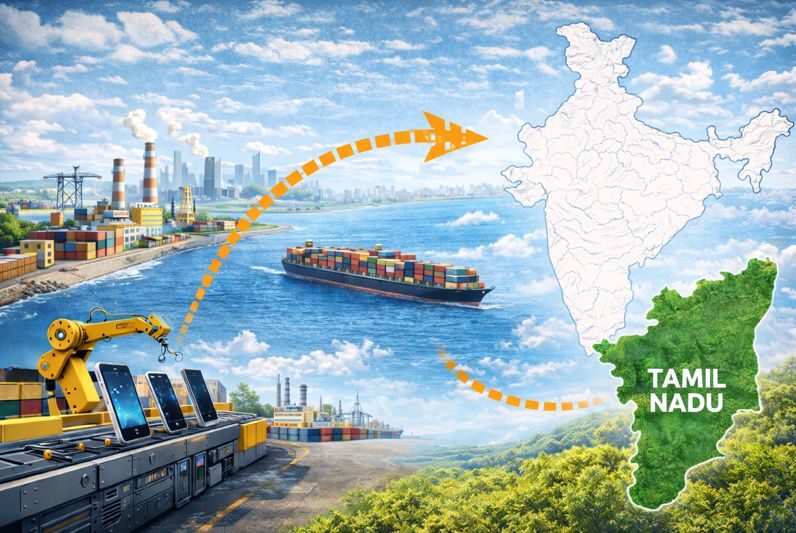
Chennai- According to economist and former Chief Economic Advisor Arvind Subramanian, as global corporations reassess their dependence on China for manufacturing, Tamil Nadu has emerged as one of India’s most attractive alternatives. Subramanian discussed the changing landscape of global supply chains, noting that businesses seeking stability, scalability, and operational continuity are increasingly turning to regions with established industrial ecosystems, where Tamil Nadu stands out.
Companies are shifting away from China for several reasons, including increasing manufacturing costs, geopolitical uncertainty, and the need to diversify supply chains in response to recent global disruptions. In this context, Tamil Nadu’s well-established manufacturing base offers a smoother transition compared to locations that are still developing their basic infrastructure. The state’s experience in managing large export-oriented businesses reduces execution risks for international corporations.
What sets Tamil Nadu apart
Industrial Depth:
Tamil Nadu has established integrated industrial clusters for automobiles, electronics, textiles, and heavy engineering, enabling businesses to connect with existing supplier networks.
Skilled Workforce:
Years of industrial activity have created a workforce with technical skills and shop-floor knowledge, reducing training time and operational delays.
Investors prefer consistency, and Tamil Nadu’s consistent approach to industrial policy ensures long-term confidence in capital-intensive projects.
Subramanian emphasized that while different Indian states are vying for global investments, Tamil Nadu stands out due to its capacity for large-scale execution. For companies looking to move operations away from China, speed is essential. Relocating to a state that has established infrastructure, ports, and logistics can significantly shorten the time needed to start production. This practical advantage often outweighs the short-term incentives offered by other regions.
The significant influx of investment into Tamil Nadu has led to notable advancements in export development, especially in the electronics manufacturing and automotive components sectors. These industries are closely integrated into global value chains, positioning the state as a clear beneficiary of the “China-Plus-One” policy. As this transition unfolds, it is expected to enhance India’s role as a viable manufacturing alternative in Asia, while also generating jobs and fostering regional economic growth.
Looking ahead, Subramanian highlighted that Tamil Nadu’s performance offers a vital lesson for India’s overall economic strategy: global investors are influenced not just by incentives, but also by consistent execution, workforce training, and interconnected ecosystems. As companies continue to restructure their supply chains, Tamil Nadu’s model could serve as an example for other regions aiming to attract long-term industrial investment.
Tamil Nadu is influencing the future of manufacturing investment, from global supply chains to local growth.
You can also subscribe to our YouTube channel InfraTalks