
Pratishtha Kashyap – In recent years, India has witnessed a disturbing rise in serious crimes ranging from sexual
violence and acid attacks to mob lynching and crimes against vulnerable communities. Each such
incident initially triggers widespread public outrage, protests, and media attention. However, as
time passes, this collective voice gradually fades, while the victims and their families continue to
struggle for justice. The growing gap between crime and punishment has raised serious concerns
about whether delayed justice is undermining the very purpose of the legal system. For many, the
prolonged wait not only weakens hope but also questions the effectiveness of justice delivery in
modern society.
Massive Backlog Burdening the Judiciary
One of the most critical challenges confronting India’s justice delivery system continues to be
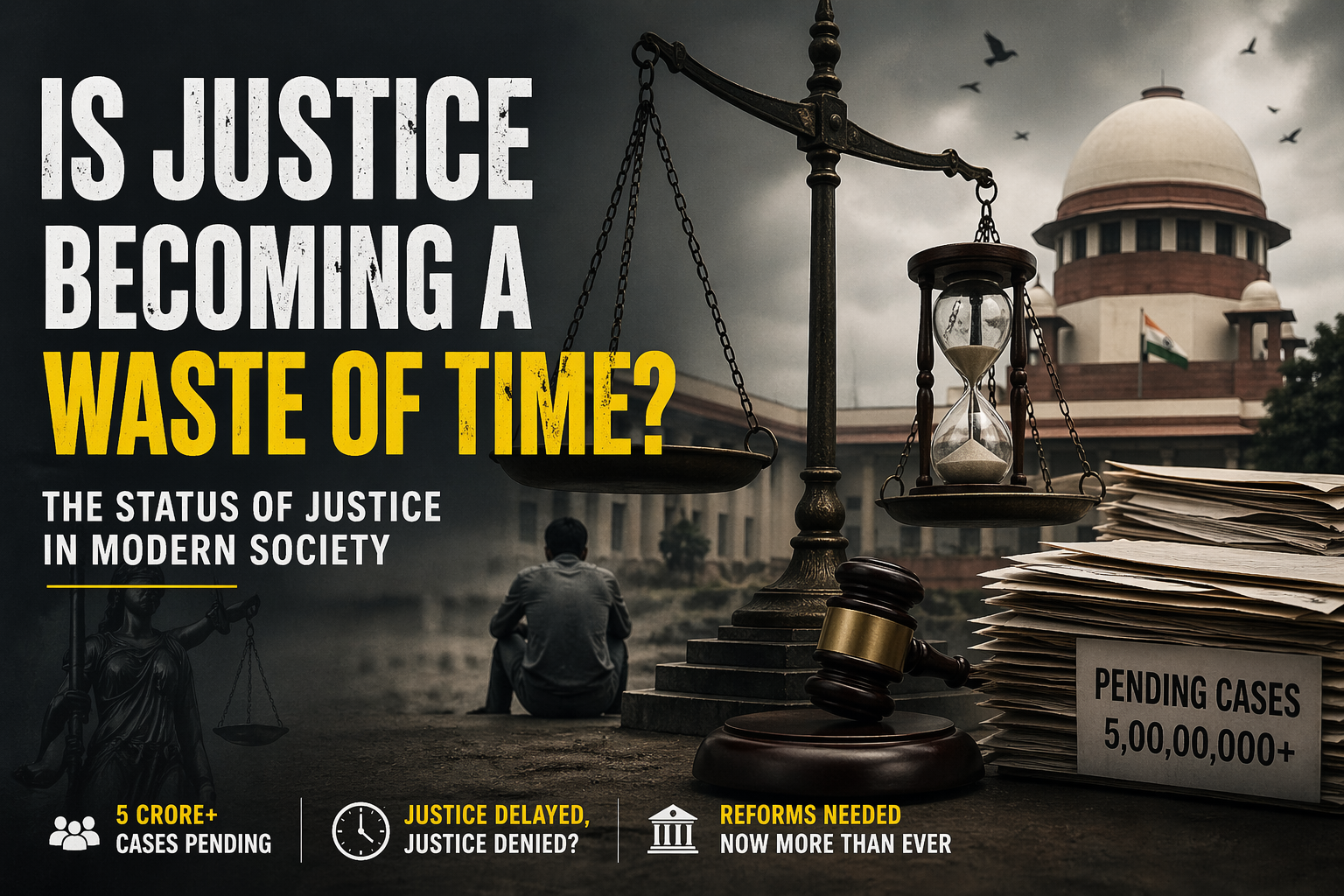
the mounting pendency of cases across courts. As per the latest available data, over five crore
cases remain pending nationwide, placing sustained pressure on judicial infrastructure. The
burden is particularly visible at the state level, where disparities in case disposal and judicial
capacity further aggravate delays. In Bihar, pending cases in district and subordinate courts are
estimated at approximately 28 to 30 lakh, reflecting significant strain on the lower judiciary and
prolonged timelines for case resolution. The national capital, Delhi, despite relatively better
infrastructure and higher judge-to-population ratios, continues to report nearly 11 to 12 lakh
pending cases across its courts, driven largely by dense urban litigation and a high volume of
civil and criminal filings. Similarly, Assam records an estimated 5 to 6 lakh pending cases,
indicating that judicial backlog is not confined to larger states but remains a widespread
structural concern.
This growing pendency has direct implications for the efficiency of the justice system, often
resulting in repeated adjournments, extended intervals between hearings, and delays that can
span several years. Legal experts and judicial observers have consistently emphasized that such
delays undermine timely justice delivery and weaken public confidence in the system. The data
underscores the urgent need for systemic reforms aimed at improving case disposal rates,
strengthening judicial capacity, and ensuring faster access to justice across all levels of the
judiciary, including the Supreme Court of India.
Recent Verdicts Highlight Systemic Delays
The issue of delayed justice has once again come into sharp focus with developments in the
Abhijit Nath mob lynching case, widely remembered as the Karbi Anglong lynching case. The
crime took place on 8 June 2018 in Panjuri village of Karbi Anglong district in Assam, where
two young men—Abhijit Nath and Nilotpal Das—were brutally killed by a mob on suspicion of
being child kidnappers. The incident, which was widely circulated on social media through
disturbing videos, led to nationwide outrage. Reports indicated that over 40 individuals were
involved, with many later identified and arrested during the investigation. The trial was
conducted in an Assam court under heightened public scrutiny, and in recent developments,
several accused were convicted by the trial court, marking a significant—though delayed—step
toward justice.
However, the gap of nearly eight years between the crime and the delivery of key judicial
outcomes has raised serious concerns about the pace of the legal process. During this prolonged
period, the families of the victims endured immense emotional trauma, social pressure, and
financial hardship while waiting for closure. Legal experts note that such delays often weaken
the strength of cases, as evidence can deteriorate, witnesses may turn hostile or unreliable, and
public attention gradually fades. The case underscores a broader systemic issue, where even in
high-profile incidents, timely justice remains a challenge, thereby impacting both public
confidence and the deterrent value of the law.
Prolonged Legal Battles in High-Profile Cases
Several high-profile and sensitive cases continue to highlight systemic delays and complexities
within the legal framework. A prominent example is the ongoing investigation into the death of
noted Assamese singer Zubeen Garg, who died on 19 September 2025 in Singapore under
circumstances that initially appeared accidental but later triggered a criminal probe. According to
official findings, the singer died after drowning during a yacht outing, though multiple
allegations of negligence and conspiracy led to the formation of a Special Investigation Team
(SIT).
The case involves seven accused individuals, including event organiser Shyamkanu Mahanta,
manager Siddhartha Sharma, and others who were present during the incident. Investigators later
added serious charges, including murder and criminal conspiracy, against several accused, and
a detailed chargesheet running into thousands of pages has already been filed before a court in
Guwahati.
Despite these developments, the legal process remains ongoing, with court proceedings, charge
framing, and hearings continuing months after the incident. In recent updates, arguments are still
being presented before a special fast-track court, indicating that the trial is far from conclusion.
The passage of time has raised concerns among observers about delays in delivering justice, as
families and the public continue to await clarity and closure.
This case reflects a broader trend seen across the country, where even high-profile matters
involving significant public attention take considerable time to reach final judgment. Legal
experts point out that prolonged proceedings not only increase uncertainty for victims’ families
but also allow accused individuals to seek legal relief such as bail during the trial process, further
extending the timeline of justice.
Emotional and Financial Toll on Families
The impact of delayed justice extends far beyond legal proceedings, deeply affecting the
everyday lives of victims’ families. In the Abhijit Nath mob lynching case, the family of Abhijit
Nath has repeatedly spoken about the emotional devastation and prolonged wait for justice since
the 2018 incident. In media interactions over the years, family members expressed that while
arrests were made, the slow pace of the trial left them feeling that “justice is moving, but too
slowly to heal the loss.” They highlighted how repeated court dates, travel, and legal expenses
added to their hardship, while the trauma of losing a loved one remained unresolved.
A similar sense of frustration has been echoed in the case related to singer Zubeen Garg, where
family members, including Garima Garg, have conveyed disappointment over the pace of
proceedings. In interviews, concerns have been raised about delays in reaching a conclusive
outcome, with the family emphasizing that “every passing month without closure deepens the
pain and uncertainty.” Such statements reflect a broader sentiment among victims’ families, who
often feel that the justice process itself becomes an extended struggle.
These examples underline a harsh reality: beyond financial strain caused by prolonged legal
battles, families endure continuous emotional stress, social pressure, and, in some cases,
intimidation. The repeated need to revisit traumatic events during hearings, combined with
delays in final judgment, reinforces the perception that the pursuit of justice can become a long
and exhausting ordeal rather than a timely source of relief.
Declining Fear of Law Among Offenders
Another serious concern arising from delays in the judicial process is the diminishing fear of law
among offenders. When cases take years to reach a conclusion, it creates a perception that
punishment is uncertain and distant. Many accused individuals operate under the assumption that
they can secure bail and prolong proceedings through repeated adjournments. This lack of
immediate accountability weakens the deterrent effect of the legal system and may contribute to
an increase in criminal activities, as the consequences of unlawful actions are neither swift nor
certain.
A relevant example can be seen in the Abhijit Nath mob lynching case, where despite the
seriousness of the crime and the large number of accused, the judicial process extended over
several years. During this period, multiple accused sought bail at different stages of the trial,
reflecting how prolonged proceedings can provide opportunities for legal relief before final
conviction. Legal observers have noted that such delays can dilute the immediacy of punishment,
thereby weakening its impact as a deterrent.
Similarly, in several high-profile cases of sexual violence, including those following the 2012
Delhi gang rape case, although convictions were eventually secured, the long duration of appeals
and legal procedures highlighted how extended timelines can affect public perception of justice.
Experts argue that when punishment is delayed, its psychological impact on potential offenders
is reduced, reinforcing the belief that consequences can be postponed, if not avoided.
These instances underline a broader systemic issue, where delays not only affect victims but also
shape offender behaviour, ultimately challenging the effectiveness of the legal system in
preventing crime.
Urgent Need for Judicial Reforms
In light of these challenges, there is a growing and urgent demand for structural reforms to
ensure timely and effective justice delivery. Legal experts and policymakers have repeatedly
stressed that merely increasing the number of courts is not enough; what is required is a systemic
overhaul of how cases are managed and heard. One of the key suggestions is the introduction of
time-bound hearings, particularly in serious criminal cases such as rape, murder, and mob
violence, where court dates should be scheduled within shorter intervals instead of months-long
gaps. Fast-track courts must not only be expanded but also strictly monitored to ensure that cases
are concluded within fixed timelines.
Another crucial reform involves ensuring that court dates are allotted promptly, especially
after the filing of chargesheets, so that trials begin without unnecessary delay. The practice of
frequent adjournments, often sought on procedural grounds, needs stricter regulation to prevent
misuse. Legal experts have also suggested implementing a case management system where
judges actively track progress and set clear deadlines for each stage of the trial.
Strengthening witness protection mechanisms is equally important, as delays often lead to
witnesses turning hostile due to fear or pressure. Ensuring their safety and timely examination
can significantly improve conviction rates. Additionally, the wider use of digital technology,
including e-courts, virtual hearings, and online documentation, can help reduce administrative
delays and improve efficiency across all levels of the judiciary, including the Supreme Court of
India.
Further, there is a need to increase the judge-to-population ratio, fill existing vacancies at a
faster pace, and provide better infrastructure in lower courts where the bulk of cases are pending.
Introducing evening or special courts for specific categories of cases has also been proposed as
a way to reduce backlog. Collectively, these reforms aim to ensure that justice is not only
delivered but delivered in a timely manner, thereby restoring public trust and reinforcing the rule
of law.
Restoring Faith in Justice
In conclusion, while the Indian judiciary continues to uphold the rule of law, the persistent
delays in delivering justice have raised critical concerns about its effectiveness. For many
victims and their families, justice delivered after years of waiting often loses its significance.
Ensuring timely and efficient resolution of cases is therefore crucial, not only to provide relief to
those affected but also to maintain public trust in the legal system. As the nation moves forward,
strengthening the speed and accessibility of justice must remain a top priority.
This article is written by Pratishtha Kashyap, a postgraduate student at the Central University of Himachal Pradesh. It is part of her academic project, which requires her to publish articles on relevant social issues. Through this piece, she aims to highlight important concerns around the justice system and contribute to meaningful public discussion.