
Annual Exchange of Nuclear Facility Lists Continues in 2026
2 January, 2026
Yogesh Sharma- India and Pakistan exchanged lists of their nuclear installations and facilities on January 1, 2026. This ongoing diplomatic practice has continued for over three decades. The exchange occurs under a bilateral agreement aimed at preventing attacks on sensitive nuclear infrastructure and reducing the risk of catastrophic escalation between the two nuclear-armed neighbours.
Despite ongoing political tensions and security challenges, this annual exercise has remained uninterrupted, making it one of the most enduring confidence-building measures between India and Pakistan.
In a region shaped by rivalry, restraint remains the strongest safeguard.
What Is the 1988 Non-Attack Agreement?
The exchange of nuclear installation lists is regulated by the Agreement on the Prohibition of Attack against Nuclear Installations and Facilities. This agreement was signed on December 31, 1988, and came into force on January 27, 1991, after both countries completed the ratification process.
The initial exchange of information under this agreement took place on January 1, 1992, establishing a yearly process that continues to this day.
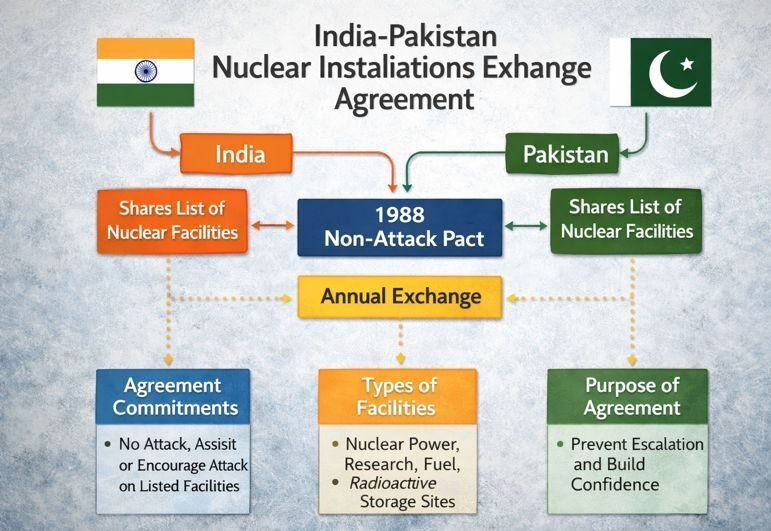
Under the agreement, India and Pakistan mutually commit to refraining from attacking, assisting, or encouraging attacks on each other’s nuclear installations under any circumstances.
Which Nuclear Facilities Are Covered?
The agreement applies to a wide range of nuclear infrastructure that could pose serious safety and environmental risks if damaged. These include:
- Nuclear power plants and research reactors
- Fuel fabrication and reprocessing facilities
- Uranium enrichment and isotope separation plants
- Storage sites containing fresh or spent nuclear fuel
- Facilities handling significant radioactive material
Each year, both countries exchange details of these sites, typically including their names and geographic locations, through diplomatic channels.
Why the Annual Exchange Is Important
The primary objective of the agreement is nuclear risk reduction, not arms control or disarmament. Even a conventional military strike on a nuclear facility could result in radiological contamination, large-scale civilian harm, and uncontrollable escalation.
By clearly identifying nuclear sites and formally protecting them from attack, the agreement helps reduce the chances of miscalculation or accidental targeting, especially during military crises.
It also provides a basic level of predictability and transparency in an otherwise fragile bilateral relationship.
Limitations of the Agreement
While significant, the pact has clear boundaries. It does not place any restrictions on nuclear weapons development, missile programmes, or strategic doctrines. It also does not cover military bases, missile storage sites, or command and control centres associated with nuclear forces.
There is no independent verification or inspection mechanism, meaning the agreement depends entirely on mutual restraint and political will rather than enforcement.
Why the Pact Has Endured Despite Tensions
What makes the agreement notable is its longevity. The annual exchange has continued even after major confrontations such as the Kargil conflict, the 2001–02 military standoff, the Uri terror attack, and the Pulwama–Balakot crisis.
The pact was originally conceived in the late 1980s, when both countries were advancing nuclear capabilities but had not yet conducted nuclear tests. Fears of preemptive strikes on nuclear facilities in a volatile region led to the need for a formal non-attack understanding.
After India and Pakistan declared themselves nuclear-armed states in 1998, the relevance of the agreement only increased.
A Quiet but Crucial Confidence-Building Measure
While the agreement does not resolve broader disputes between India and Pakistan, it plays a critical role in maintaining nuclear safety and regional stability. In a region where misjudgements can have irreversible consequences, the annual exchange of nuclear installation lists remains a subtle yet vital safeguard against disaster.
Here is a flowchart image to help you understand the process more clearly:
Sometimes, the most important agreements are the ones that quietly prevent the worst from happening.
To read more such Latest News
visit our Homepage
Do Subscribe to our Youtube Channel InfraTalks