

January 2, 2026
New Delhi – The Indian Space Research Organisation (ISRO) has announced one of its most ambitious plans yet to deploy satellites. Over the next three years, ISRO aims to launch between 100 and 150 additional satellites to significantly enhance national border security and coastal surveillance. This announcement was made by ISRO Chairman Dr. V. Narayanan during a public event in Chennai in April 2025.
During an event on April 23, 2025, Dr. Narayanan revealed the deployment plan and explained the urgent need to expand India’s satellite fleet beyond the current approximately 55 operational spacecraft.
The initiative is being spearheaded by ISRO, led by Dr. V. Narayanan, who also holds the position of Secretary of the Department of Space. This strategic effort is part of a larger set of reforms in the space sector introduced by Prime Minister Narendra Modi, which aims to encourage increased private participation in satellite manufacturing and launch services within India’s space ecosystem.
These reforms aim to speed up the production and launch of satellites by permitting Indian private companies to manufacture satellites and launch vehicles, with ISRO offering technical guidance and support.
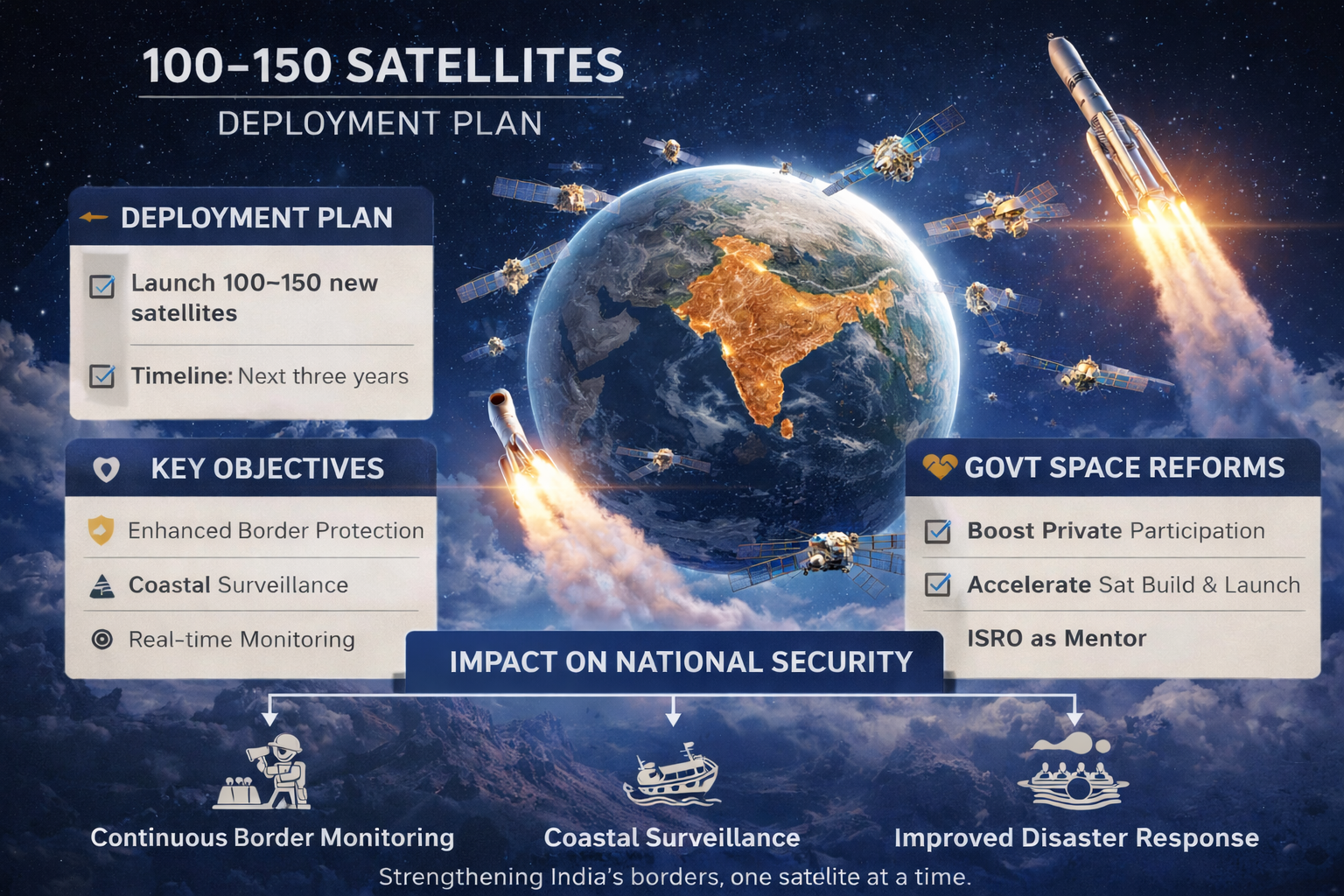
This ambitious plan is based on the recent space sector reforms initiated by the central government, which aim to transform India’s space ecosystem. These reforms allow private Indian companies to engage in satellite manufacturing, launch vehicle development, and space-based services, while ISRO acts as a technology enabler and mentor. Dr. Narayanan noted that although ISRO currently operates around 50–60 satellites, this number is insufficient for maintaining round-the-clock surveillance across India’s vast borders and maritime zones. Therefore, it is essential to rapidly increase the number of satellites.
The planning for the satellite expansion has become more urgent due to rising security challenges and the growing need for real-time situational awareness. ISRO’s leadership has emphasized that space-based assets are essential for detecting infiltration attempts, monitoring suspicious movements, and providing timely and accurate data to support defense forces. The proposed satellites are expected to feature advanced earth observation systems capable of high-resolution imaging, nighttime monitoring, and all-weather surveillance. This will significantly enhance India’s ability to track developments along its borders.
Once deployed, the expanded satellite constellation is expected to have a significant impact on national security. It will enhance border surveillance, improve coastal monitoring, and increase maritime domain awareness. Additionally, it will support disaster management, environmental monitoring, and internal security operations. Beyond defense, this initiative is likely to accelerate growth in India’s private space industry, create high-skill jobs, and strengthen the country’s position as a leading space-faring nation.
Future Impact on National Security
Once it becomes operational, the expanded satellite network will have several impacts:
- Continuous Border Monitoring:
More satellites will provide denser and more frequent monitoring of border regions, discouraging infiltration and hostile maneuvers. - Coastal Surveillance:
Improved space-based observation would boost maritime domain awareness, particularly along India’s lengthy coastline. - Improved Disaster Response:
Many satellites will most certainly carry improved sensors that can be used for environmental monitoring and disaster management in addition to defense. - Technological Leadership:
A larger constellation strengthens India’s strategic position among spacefaring nations, aligning with broader aims of self-reliance and technological superiority.
Overall, ISRO’s proposal to add 100 to 150 satellites represents a crucial step towards a more secure, self-reliant, and technologically advanced India.
“This ambitious expansion underscores how space technology is becoming central to India’s national security architecture.”
For more content and updates, visit our YouTube channel:
InfraTalks
To read more such Latest News
visit our Homepage